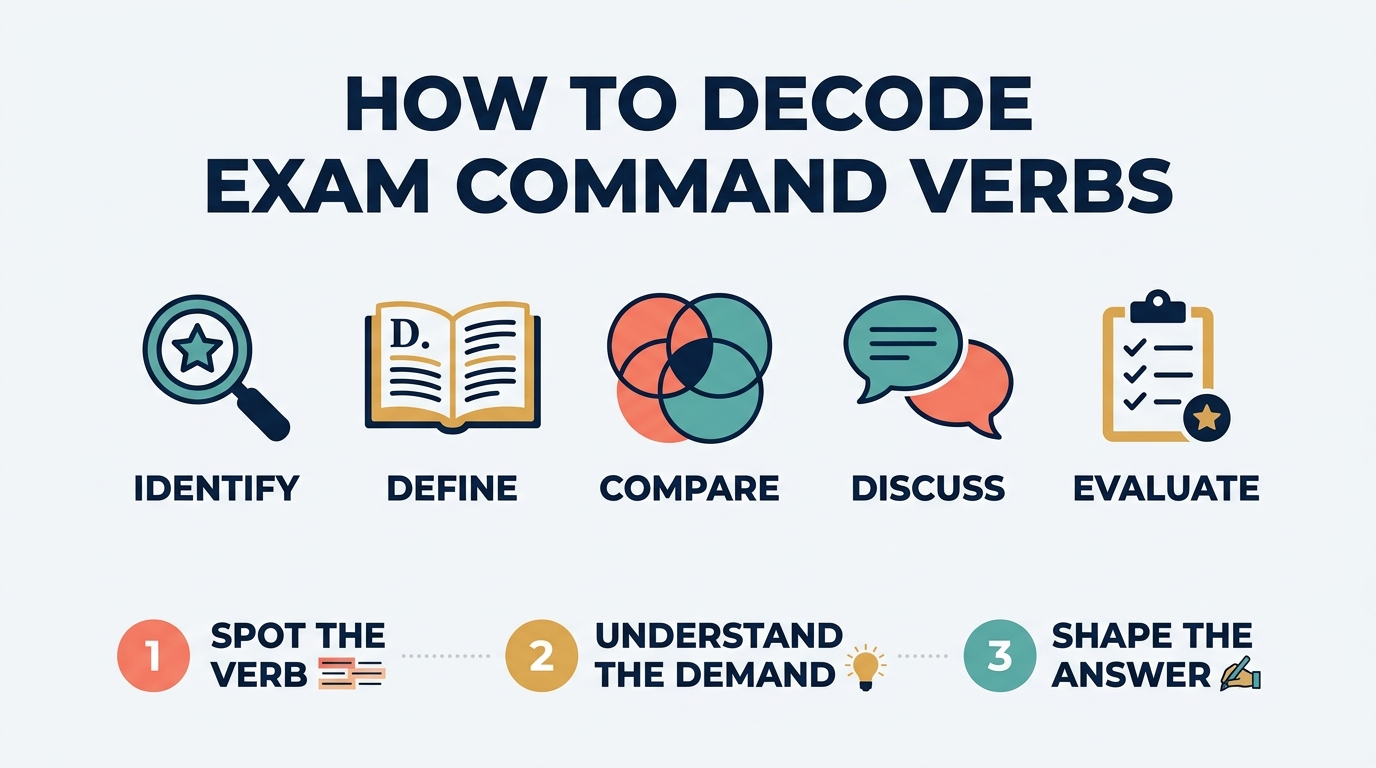
How to Easily Decode SA DBE Exam Command Verbs
Your child read the question three times, wrote a perfect paragraph of content, and still lost half the marks. Why? Because the question said “evaluate” and they wrote a “describe” answer instead.
This isn’t a content problem. It’s a decoding problem, and it’s costing South African matrics thousands of marks every single year. The National Senior Certificate (NSC) exam doesn’t just test what you know — it tests whether you can follow an instruction precisely, under pressure, in a sealed exam hall with the clock ticking.
Command verbs are the single most under-taught skill in the matric curriculum. Teachers teach content. Nobody teaches the language of the question paper itself. That’s the gap we’re closing today, and tools like the Matric Emergency Triage Bundle exist precisely because this gap is so widespread and so fixable.
Key Takeaways: Decode SA DBE Exam Command Verbs
- Command verbs instruct HOW to answer — not what topic to write about — and markers allocate marks strictly based on matching your response to that verb.
- “Describe” and “explain” are not interchangeable: describe wants the “what,” explain wants the “why” or “how,” and confusing them is the number one reason for lost marks in Life Sciences and Geography.
- Command verbs are grouped into low-order (recall), mid-order (understanding), and high-order (analysis/evaluation) categories, and knowing which tier a question sits in tells you exactly how much depth to write.
- A simple 5-step system (covered later in this article) can be applied to any NSC question, in any subject, to instantly identify what the marker is actually looking for.
- Getting this wrong isn’t a knowledge gap, it’s a technique gap — and the right diagnostic tools can fix it faster than you’d expect.
Why Command Verbs Make or Break Your Exam Marks
Think of the NSC exam as a set of instructions, not a test of memory. Every question paper — whether it’s Accounting, Physical Sciences, or English Home Language — is built around a specific action word that tells the candidate exactly what cognitive task is required.
Markers don’t mark vibes. They mark against a strict DBE marking memo, and that memo is built around the command verb in the question. If the question says “state,” the memo awards marks for a brief, factual statement. If a learner responds with three paragraphs of explanation instead, those extra sentences earn zero additional marks because they weren’t asked for. Worse, learners often run out of time over-answering a low-order question, leaving no time for the high-order question worth double the marks.
This is the heart of the Engineer’s Mindset™ approach to exam technique: diagnose the instruction first, then build your answer to match the exact specification. Nothing more, nothing less.
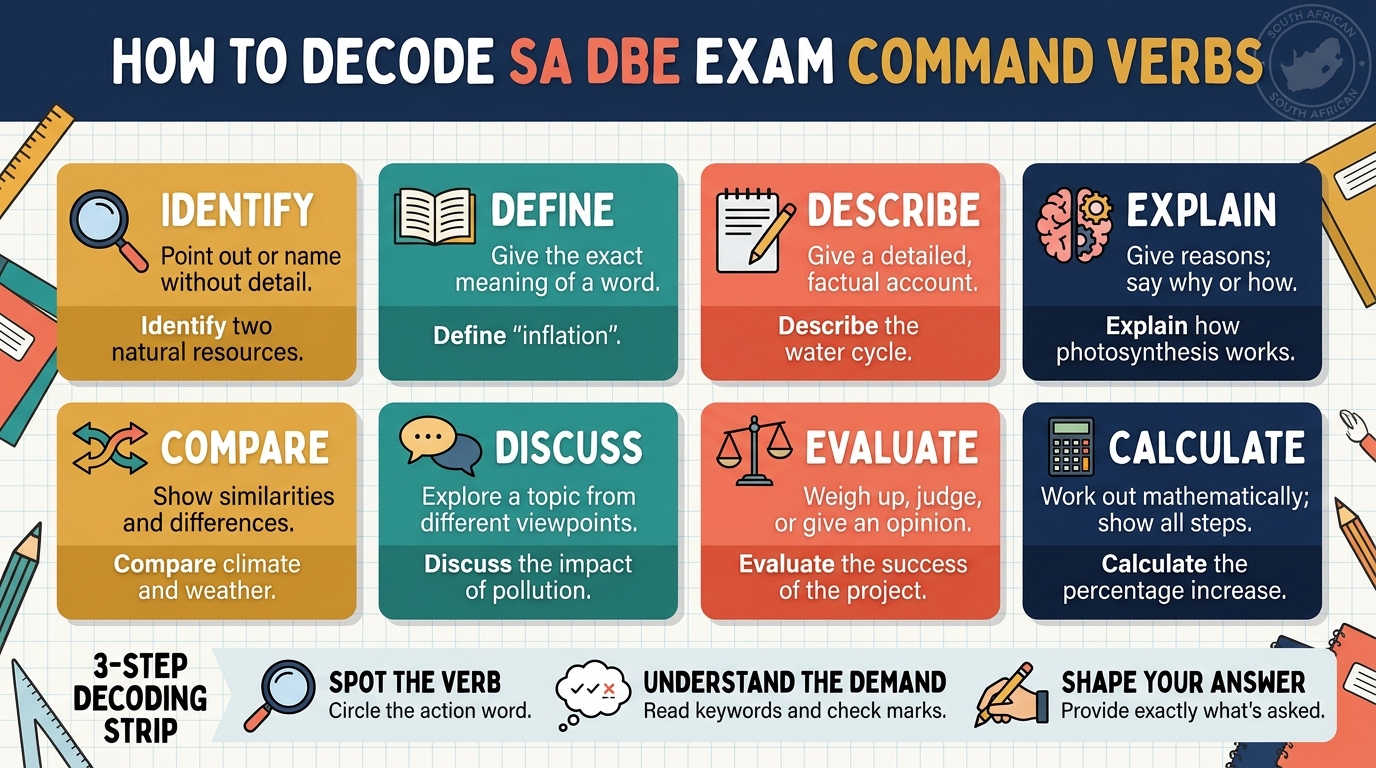
What Exactly Is a Command Verb?
A command verb is the action word in a question that tells you what to do with the information, not what the information is. Words like “define,” “discuss,” “evaluate,” and “justify” are all command verbs. They sit at the start or middle of the question and function like a set of engineering specifications — ignore them, and the final product fails inspection, no matter how good the raw materials were.
The Difference Between Command Verbs and Content Words
Content words tell you the topic. Command verbs tell you the task. In the question “Explain the causes of the Cold War,” “Cold War” is the content you already studied, but “explain” is the command that determines your answer’s structure. Learners who focus only on content words often write a correct but poorly structured answer that scores low despite accurate facts. For more insights, explore the Matric Exam Rescue Bundle which offers study guides and resources.
How Markers Use Command Verbs to Allocate Marks
Every NSC marking memo is built in direct response to the command verb used. A “list” question typically awards one mark per correct point up to the maximum, with no marks for explanation. A “discuss” question, by contrast, requires elaboration and context, and memos reward depth and linked reasoning. Understanding this mark-allocation logic lets a learner instantly gauge how much to write — a skill that saves critical exam-room minutes.
Low-Order Command Verbs: Recall and Basic Knowledge
Low-order verbs sit at the base of Bloom’s Taxonomy, and the NSC uses them constantly in Paper 1-style short-question sections across subjects like Life Sciences, History, and Geography. These verbs demand speed and accuracy, not depth. For more information on exam preparation resources, check out this Matric Exam Rescue Bundle.
Define, List, and Name
These three verbs are the simplest in the command verb family, and they reward precision over elaboration.
- Define — give the exact meaning of a term, often using terminology straight from the CAPS glossary (common in Physical Sciences and Life Sciences).
- List — provide separate points, usually as single words or short phrases, with no linking sentences required.
- Name — give the correct term, label, or example only; no justification needed.
Writing a full paragraph for a “list” question wastes time and earns nothing extra. This is a classic sign a learner hasn’t decoded the command verb correctly.
State and Identify
“State” asks for a brief, clear statement of fact — often just one sentence. “Identify” asks the learner to pick out or recognise something specific, frequently from a graph, diagram, or passage, which is especially common in Geography and Accounting source-based questions. Both verbs are speed questions: get in, answer precisely, move on.
Mention and Label
“Mention” functions almost identically to “state,” asking for a brief factual reference without elaboration. “Label” is near-exclusively used with diagrams, maps, and graphs, requiring the learner to write the correct term directly onto the given image. These verbs appear heavily in Life Sciences diagrams and Geography map work, where precision matters more than prose.
Mid-Order Command Verbs: Understanding and Application
Mid-order verbs are where most matric marks are won or lost, because they require learners to demonstrate understanding, not just recall. These verbs appear throughout Paper 2-style questions in subjects like History, Life Sciences, and Business Studies, and they’re also where confusion runs highest.
The jump from low-order to mid-order isn’t just about writing more — it’s about writing differently. A mid-order answer needs structure: a point, followed by development or reasoning, often linked with words like “because,” “which results in,” or “therefore.” For more structured writing, consider exploring the Matric Exam Rescue Bundle.
This is exactly the zone where the describe-versus-explain confusion lives, and it deserves its own close look.
Describe Versus Explain
This is, without question, the most confused command verb pair in the entire NSC curriculum. “Describe” asks for the WHAT — a detailed account of features, characteristics, or sequence of events, without needing to justify why something happens. “Explain” asks for the WHY or HOW — the reasoning, cause, or mechanism behind something.
– Describe the structure of the heart. (Give features: four chambers, valves, septum.)
– Explain why the heart has a septum. (Give reasoning: prevents mixing of oxygenated and deoxygenated blood.)
In Life Sciences and Geography specifically, markers report this as the single most common reason learners lose marks on otherwise strong answers. A “describe” answer that drifts into “because” statements earns no bonus marks for the unrequested reasoning, and an “explain” answer that only lists features without cause-and-effect will be capped at low marks regardless of length.
Outline and Summarise
“Outline” asks for the main points only, presented briefly, often in a logical sequence without full detail — think of it as a compressed version of “describe.” “Summarise” asks the learner to condense a larger body of information (often a passage or source) into its essential points, commonly seen in English comprehension and History source-based questions. Both verbs punish over-writing; the memo rewards brevity and accuracy, not word count. For more resources, consider exploring the Matric Exam Rescue Bundle.
Discuss and Comment On
“Discuss” is one of the broadest command verbs in the NSC toolkit, requiring the learner to examine a topic from multiple angles, present reasoning, and sometimes weigh different viewpoints — common in History, Life Orientation, and Business Studies. “Comment on” is similar but usually invites a more personal or evaluative response, asking the learner to give an informed opinion backed by reasoning. Both verbs demand connected, flowing paragraphs rather than disjointed points, and memos typically award marks for both content accuracy and the quality of the argument’s structure.
Classify and Distinguish
“Classify” asks the learner to sort information into categories or groups, usually using criteria taught in the CAPS curriculum — frequently seen in Life Sciences (classifying organisms) and Geography (classifying climate types). “Distinguish” asks for the differences between two or more concepts, and critically, it does NOT ask for similarities. A common error is listing similarities and differences together when only differences were requested, which costs marks because the memo only credits the specific contrast points asked for.
High-Order Command Verbs: Analysis and Evaluation
High-order command verbs sit at the top of the cognitive demand ladder, and the NSC reserves them for the questions worth the most marks — usually the final questions in Paper 2 essays, Accounting interpretation sections, and Physical Sciences application problems. These verbs don’t just ask you to know something; they ask you to do something with what you know, which is exactly where the Pit Crew Mindset becomes essential. A pit crew doesn’t just know the car’s parts, they diagnose what’s wrong under pressure and act decisively. That’s precisely the mental mode required here.
Analyse Versus Evaluate
“Analyse” asks the learner to break a concept, text, or data set into its component parts and examine how those parts relate to each other — common in Accounting ratio analysis and English literature essays. “Evaluate” goes a step further, requiring the learner to judge the worth, success, or validity of something, usually ending in a reasoned conclusion or recommendation. The mistake most matrics make is analysing beautifully and then forgetting to actually judge anything, leaving the evaluate question without the verdict the memo is specifically looking for.
Critically Discuss and Critically Analyse
Adding “critically” to a command verb raises the bar significantly. It signals that the memo expects the learner to weigh both strengths and weaknesses, consider counter-arguments, or question the validity of a statement rather than simply accepting it at face value. This phrasing appears often in History essays and Life Orientation, where a one-sided answer — even if factually correct — will be marked down for lacking the balanced, critical lens the verb demands.
Justify and Motivate Your Answer
“Justify” and “motivate” are functionally near-identical in NSC papers, both asking the learner to provide solid reasoning or evidence to support a stated opinion, choice, or conclusion. These verbs appear constantly in Mathematics (justify why a method was used), Accounting (motivate a financial decision), and Business Studies (justify a strategic recommendation).
The critical technique here: never just restate your answer as your justification. The memo wants a reason that logically supports the conclusion, not a repeat of the conclusion itself dressed in different words.
Assess and Interpret
“Assess” asks the learner to weigh up evidence and arrive at a judgement on the extent, importance, or success of something, similar to “evaluate” but often slightly more measured in tone. “Interpret” is heavily used in Geography (reading climate graphs), Mathematics (interpreting data sets), and Life Sciences (interpreting experimental results), asking the learner to explain what given data or information actually means in context.
Both verbs require the learner to go beyond surface description and demonstrate genuine understanding of significance, not just the raw facts on the page.
Command Verb Pairs Students Always Confuse
Certain command verb pairs cause confusion year after year across every DBE subject, and markers’ reports flag the same patterns repeatedly. Knowing these specific traps in advance is one of the fastest ways to protect marks that would otherwise slip away unnecessarily.
Compare Versus Contrast
“Compare” asks for both similarities AND differences between two or more things, while “contrast” asks ONLY for differences. Learners frequently default to listing only differences when “compare” is used, missing out on marks allocated specifically for similarities in the memo.
Explain Versus Justify
“Explain” asks for the reasoning behind a fact or phenomenon in a neutral, informative way, while “justify” asks the learner to defend a specific stance, choice, or decision already made. The distinction matters most in Accounting and Business Studies, where “justify” questions require you to argue in favour of a position rather than simply describing cause and effect.
Describe Versus Discuss
“Describe” wants a straightforward account of features or characteristics, while “discuss” wants a more developed treatment involving multiple perspectives, implications, or connected reasoning. A “describe” answer in point form may still score full marks, but a “discuss” answer presented only in disconnected points will almost always lose marks for lacking the expected depth and flow.
Mixing these pairs up isn’t a sign of poor subject knowledge, it’s a sign of an undiagnosed technique gap — and technique gaps are entirely fixable with focused practice on command verb recognition.
How Command Verbs Change Across Subjects
Here’s a truth few learners are told explicitly: the same command verb can demand a different style of answer depending on the subject. The DBE doesn’t apply command verbs uniformly, and understanding subject-specific expectations is part of mastering exam technique at matric level.
Command Verbs in Mathematics and Physical Sciences
In Mathematics and Physical Sciences, command verbs often blend with instructional phrasing specific to calculations and scientific method. “Calculate” demands a full working-out shown step by step, since method marks are awarded even if the final answer is wrong. “Determine” is similar to calculate but sometimes includes an element of reasoning or selecting the correct formula first. “Show that” requires the learner to prove a given statement or value through full mathematical working, not simply state that it’s true.
– Calculate the acceleration of the object. (Full formula, substitution, and final answer with units required for full marks.)
– Explain why the acceleration decreases over time. (Reasoning based on forces or resistance, not a repeated calculation.)
Physical Sciences also uses “state” for laws and principles (such as Newton’s Laws) where the exact textbook wording is often required for full marks, making memorisation accuracy non-negotiable in this subject.
Command Verbs in Languages and Life Orientation
Language subjects like English Home Language and First Additional Language use command verbs tied closely to literary and comprehension skills, where tone and interpretation carry real weight. Life Orientation leans heavily on personal reasoning and application-based command verbs, since the subject assesses values and life skills rather than pure factual recall.
- Comment — give a personal, reasoned response to a text or scenario, often requiring a point of view.
- Critically evaluate — common in literature essays, requiring judgement of a character, theme, or author’s technique with supporting evidence.
- Discuss the effectiveness of — frequently used in poetry and visual literacy, asking how well a technique achieves its intended effect.
- Suggest — often used in Life Orientation, inviting a practical recommendation based on a given scenario.
These verbs reward learners who can form and defend an opinion using evidence from the text or scenario, rather than simply summarising content. Markers specifically look for the learner’s own voice and reasoning, not a recycled textbook answer.
In Life Orientation particularly, “suggest” and “recommend” questions are marked generously when the response is practical, relevant to the scenario given, and clearly reasoned — even if it differs from the exact memo wording, provided the logic holds.
Command Verbs in History and Geography
History and Geography rely heavily on source-based command verbs, since both subjects use extracts, maps, graphs, and cartoons extensively in their exam papers. “Use the source to…” is a command phrase unique to these subjects, instructing the learner to extract evidence directly from the given material rather than relying on outside knowledge.
“Account for” is another History-specific command verb that functions similarly to “explain,” asking for the causes or reasons behind a historical event or trend. Geography frequently pairs command verbs with map or graph instructions, such as “with reference to the graph, describe,” which signals that the answer must be grounded in the specific data shown rather than general knowledge alone.

5 Steps to Decode Any Exam Question
When the exam paper is in front of you and the clock is running, you need a system, not a guess. This is the 4-Point Academic Diagnostic applied directly to command verbs, and it takes seconds once practised.
- Underline the command verb(s) first, before reading anything else in the question, so your brain locks onto the task before it locks onto the topic.
- Check the mark allocation next to the question, since marks tell you exactly how many points, reasons, or steps the memo expects.
- Match the verb to its tier — low-order (recall), mid-order (understanding), or high-order (analysis/evaluation) — to decide how much depth and linking language is required.
- Plan your answer structure in rough note form before writing, especially for “discuss,” “evaluate,” or “critically analyse” questions that need a logical flow.
- Reread the command verb after writing your answer, to check your response actually did what was asked, not just what you know about the topic.
This five-step habit takes under thirty seconds per question once it becomes automatic, and it’s precisely the kind of exam technique drilled into learners using structured matric prep tools. Mastering this sequence is often the difference between a 55% and a 70% aggregate, with content knowledge staying exactly the same.
Common Mistakes That Cost Students Marks
Most matric learners don’t lose marks because they don’t know the work. They lose marks because they answer the topic of the question instead of the instruction in the question. This distinction is subtle, but it’s responsible for more lost marks than any single content gap in the NSC curriculum.
Markers’ annual diagnostic reports, released after each November exam series, repeatedly flag the same three technique errors across subjects. Fixing these three issues alone can lift a learner’s overall mark by several percentage points without a single extra hour of content revision.
Ignoring the Command Verb and Answering the Topic Instead
This happens when a learner sees a familiar topic, like “photosynthesis” or “the French Revolution,” and starts writing everything they know about it, regardless of whether the question asked them to describe, explain, or evaluate. The memo only awards marks for content that matches the specific command, so a brilliant but misdirected answer can score poorly despite strong subject knowledge.
Writing a List When an Explanation Is Required
Bullet-pointed, disconnected facts might satisfy a “list” or “state” question, but they will not satisfy “explain,” “discuss,” or “motivate.” These verbs require linking words, cause-and-effect reasoning, and full sentences that show understanding, not just recall.
A learner who writes five isolated facts for an “explain” question worth five marks might only earn one or two marks, because the memo is specifically looking for connected reasoning between those facts, not the facts in isolation.
Missing Multi-Part Command Verbs in One Question
Many NSC questions pack two or more command verbs into a single sentence, and learners frequently answer only the first instruction while ignoring the second completely.
- “Describe the process AND explain its significance” requires two distinct parts: a factual account followed by reasoning.
- “Identify the trend AND account for it” needs a one-line observation plus a full causal explanation.
- “Discuss the advantages AND disadvantages” demands balanced treatment of both sides, not just one.
- “Calculate the value AND comment on your answer” requires full working plus a separate interpretive sentence.
Missing the second half of a compound command verb question is one of the most common and most preventable mark losses in the entire NSC exam system. The fix is simple but non-negotiable: every time a question contains “and,” check whether it’s joining two command verbs rather than two pieces of content.
This single habit, checking for compound instructions, recovers marks that many learners don’t even realise they’re losing. It costs nothing to implement and takes seconds once trained.
Practising past papers with a deliberate focus on underlining every command verb, rather than just reading for content, retrains the eye to catch these compound structures automatically under exam pressure.
Quick Reference Guide for Command Verbs
| Command Verb | Cognitive Level | What the Memo Expects |
|---|---|---|
| Define / List / Name | Low-order | Brief, factual, no explanation needed |
| Describe | Mid-order | Detailed account of features or sequence (the “what”) |
| Explain / Account for | Mid-order | Reasons, causes, or mechanisms (the “why/how”) |
| Discuss | Mid-order to high-order | Multiple angles, connected reasoning, flowing paragraphs |
| Compare | Mid-order | Similarities AND differences |
| Contrast / Distinguish | Mid-order | Differences only |
| Analyse | High-order | Break into parts, examine relationships |
| Evaluate / Assess | High-order | Judge worth or success, reach a conclusion |
| Justify / Motivate | High-order | Defend a stance with logical supporting reasons |
| Critically discuss/analyse | High-order | Weigh strengths and weaknesses, consider counter-views |
Keep this table close during revision sessions, not just before the exam. Repetition builds instinct, and instinct is what carries a learner through under genuine exam pressure.
Turn Command Verb Mastery Into Higher Marks
Command verb fluency isn’t a once-off lesson, it’s a muscle built through repetition across every subject and every past paper a learner touches. The learners who consistently score in the 70s and 80s aren’t necessarily smarter, they’ve simply internalised the language of the question paper until decoding it becomes instinctive rather than effortful.
If exam panic is already setting in, the Instant Calm Protocol™ helps here too: pause, underline the command verb, breathe, and apply the 5-step system above before writing a single word. This small ritual interrupts panic-driven guessing and replaces it with structured, confident action, exactly the mindset shift that turns last-minute revision into real, bankable marks.
FAQ’s About How To Decode SA DBE Exam Command Verbs
What Is the Difference Between Describe and Explain in an Exam?
“Describe” asks for the features, characteristics, or sequence of something — the “what” of the answer, without needing reasons. “Explain” asks for the causes or reasoning behind something — the “why” or “how,” requiring cause-and-effect links. Confusing these two is the most common source of lost marks in subjects like Life Sciences and Geography.
How Many Marks Should I Expect for an Evaluate Question?
“Evaluate” questions typically carry higher mark allocations, often four marks or more, because they require a full judgement with supporting reasoning rather than a simple fact. The exact mark value is always indicated next to the question itself, so always check that figure first. Match your answer’s length and depth to that number rather than guessing.
Do Command Verbs Mean the Same Thing in Every Subject?
No, the same command verb can shift slightly in meaning depending on the subject’s demands. “Calculate” in Mathematics requires full working, while “calculate” in Accounting may require a specific formatted answer like a ratio or percentage. Always check subject-specific marking guideline examples through past papers to see how each verb is applied in context.
What Should I Do If a Question Has Two Command Verbs?
Answer both parts fully and separately, since the memo allocates distinct marks for each command verb within the question. Underline every command verb before writing to make sure none are missed, especially when “and” joins two instructions together. Structure your answer so each part is clearly addressed, rather than blending both into one vague response.
Where Can I Find an Official List of DBE Command Verbs?
The Department of Basic Education publishes subject-specific examination guidelines each year, which include notes on command verb expectations for that subject. These guidelines are available on the official DBE website under each subject’s examination resources. Past paper marking memos are also an excellent practical source, since they show exactly how each command verb was rewarded in real exam conditions.