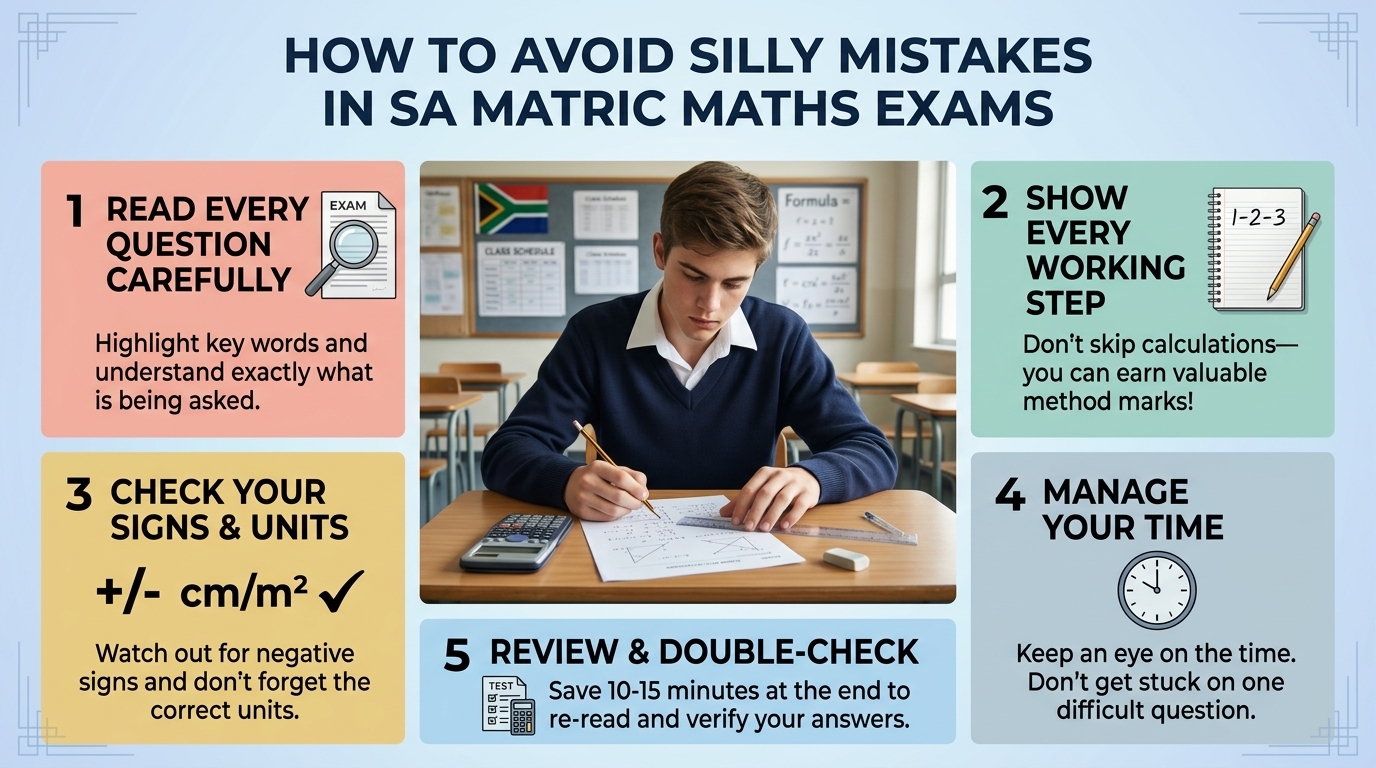
How To Avoid Silly Mistakes in SA Matric Maths Exams
Your learner knows the work. They’ve done the past papers, sat through the extra lessons, and can explain the quadratic formula in their sleep. Then the exam paper lands in front of them, and somehow a simple sign error, a misread question, or a rushed final line costs them 6, 8, sometimes 12 marks they absolutely should have kept. If that sounds painfully familiar, you’re not alone — and it’s not a maths problem. It’s a system problem.
Key Takeaways: How To Avoid Silly Mistakes in SA Matric Maths Exams
- Silly mistakes are rarely silly — they are almost always a symptom of exam-room anxiety, rushed reading, or poor method-mark habits, not a lack of ability.
- Marking errors are made “visible” when you master DBE maths marking rules, because examiners reward correct method even when your final answer is wrong.
- A structured check-system (what we call the 4-Point Academic Diagnostic) catches sign errors, unit mistakes, and misread questions before you hand in your script.
- Growth-mindset thinking, backed by a real South African study on 301 Cape Town learners, can measurably shift how students respond to difficult questions under pressure.
- We’ll unpack exactly how to build an exam-day routine — stick around for the Instant Calm Protocol™ later in this article, because panic is where most silly mistakes are born.
Every year, thousands of Matric learners walk out of their NSC Maths exam saying the same thing: “I knew how to do that.” The gap between knowing the content and knowing how to avoid silly mistakes in SA Matric Maths exams is where most marks are lost — and won. For learners who want a subject-by-subject breakdown of exactly where these errors happen and how to close the gap fast, our Subject-Specific Rescue Tactics bundle walks through the exact checklists examiners use when they mark your script.
This article isn’t about telling you to “be more careful.” That advice has never once fixed a silly mistake. Instead, we’re going to diagnose exactly why these errors happen, build you a repeatable system to catch them, and show you how to execute that system under real exam pressure — the same way a pit crew services a race car in seconds, not minutes.
The Hidden Reason You Keep Losing Easy Marks
Here’s the uncomfortable truth: most “silly mistakes” aren’t about maths knowledge at all. They’re about stress physiology. When a learner’s brain perceives an exam question as threatening — because the wording is unfamiliar, or time is running out — it triggers a stress response that narrows attention and speeds up decision-making. That’s a useful survival mechanism if you’re being chased by a lion. It’s a disaster when you’re trying to carefully substitute values into the quadratic formula.
This is why a learner who scores 85% in a calm classroom test can drop to 60% in the real exam, despite knowing the same content. The problem isn’t the syllabus. It’s how their nervous system handles pressure, and whether they have a structured technique to fall back on when that pressure hits.
Your Brain Treats Maths Stress as a Warning Sign
Research on mathematics anxiety consistently shows that people with higher anxiety levels are more likely to avoid tasks that involve numbers — even when they’re capable of doing them. In an exam, this avoidance doesn’t look like walking out of the room. It looks like skimming instead of reading, rushing through a calculation to “get it over with,” or freezing on a question and guessing rather than working through it methodically. All three are direct causes of the errors we call “silly.”
A fixed mindset makes this worse. If a learner believes their maths ability is “just how they are” — good or bad — they interpret stress as proof the task is too hard, and disengage. A growth mindset interprets the same stress response as functional: a signal to slow down and apply a known strategy. The difference in outcomes between these two mental models is measurable, not just motivational fluff.
Why South African Students Underperform Globally
South African learners consistently underperform on international mathematics benchmarks like TIMSS, and the gap isn’t only about curriculum content. It tracks closely with socioeconomic background, home environment, and — critically — the psychological relationship learners have with the subject itself. Understanding this matters, because it tells us something important for exam strategy:
- Poverty and under-resourced schooling account for a significant share of the learning gap between wealthier and poorer students in South Africa.
- Countries with generally higher reported mathematics anxiety perform worse on international assessments than countries with lower anxiety levels.
- Beliefs and exam-day behaviours are malleable — meaning they can be changed with the right intervention, even in a short space of time before finals.
That last point is the one that should give every Matric learner hope. You cannot rewrite your home circumstances in the weeks before your NSC exam. But you absolutely can rewrite your exam-day habits, your checking system, and your response to pressure — and that’s where real marks get recovered.
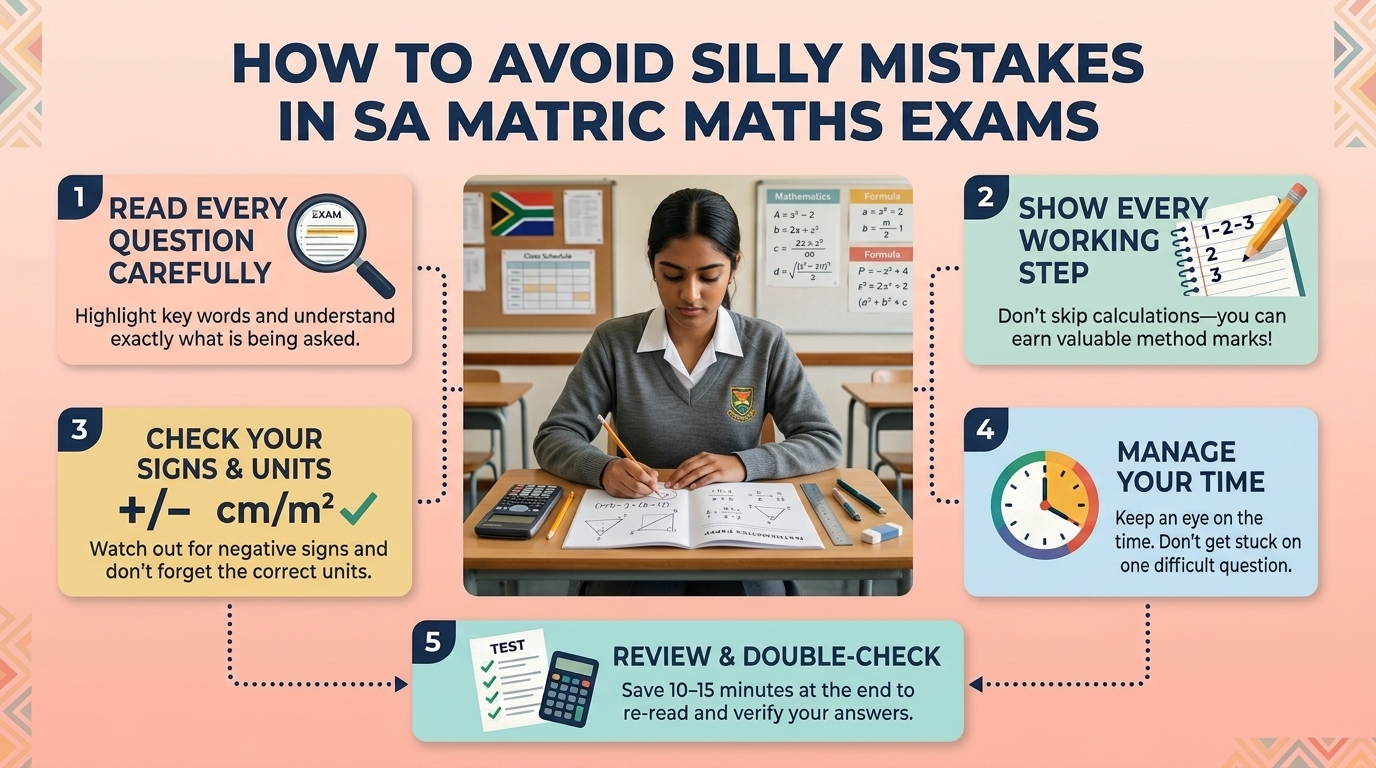
How Maths Anxiety Causes Silly Mistakes
Let’s get specific about the mechanism, because vague advice like “stay calm” doesn’t help anyone under real exam conditions. Maths anxiety produces physical, cognitive, and behavioural symptoms — a racing heart, a mind that goes blank, hands that rush through writing. Each of these directly causes a specific category of exam error.
The Direct Link Between Anxiety and Lower Test Scores
Studies measuring mathematics anxiety alongside test performance find a consistent negative correlation: as anxiety rises, scores fall. This isn’t about intelligence. A highly anxious learner’s working memory gets partially “hijacked” by worry, leaving less mental capacity available for the actual calculation in front of them. That’s precisely how a learner drops a negative sign, forgets to convert units, or copies a number incorrectly from one line of working to the next.
Why High-Anxiety Countries Score Worse on PISA Tests
International PISA data shows a pattern worth paying attention to: countries reporting higher average mathematics anxiety tend to score lower overall, compared to countries with lower reported anxiety. This supports a core idea in the Engineer’s Mindset™ approach — technique and emotional regulation aren’t separate from maths performance, they’re a direct input into it. You cannot out-study anxiety. You have to build a system that neutralises it on the day.
How Avoidance Behaviour Creates Careless Errors
When a question looks unfamiliar — a Physical Sciences calculation with an unusual unit, or a Maths Paper 2 question combining trigonometry with geometry — anxious learners often rush to “just get an answer down” rather than working through it step by step. This avoidance-driven rushing is the single biggest cause of silly mistakes in the NSC exam room. The fix isn’t more content knowledge. It’s a deliberate, practised slowing-down technique applied specifically to questions that trigger that panic response.
The Neuroplasticity Lesson Behind Fewer Errors
Your brain isn’t a fixed container of maths ability that either has room in it or doesn’t. Every time you work through a tricky simultaneous equation or correct yourself mid-calculation, you’re physically strengthening neural pathways. This is the exact message a Cape Town-based intervention used with Grade 8 and 9 learners under the banner “Maths Brain Tricks” — week one taught learners that the brain behaves like a muscle, and the more it’s worked, the stronger it becomes.
Why does this matter for a Matric learner three months from finals? Because learners who believe their ability is fixed tend to shut down the moment a question looks unfamiliar, and shutting down is exactly when silly mistakes multiply. Learners who understand the neuroplasticity principle treat a hard question as a rep in the gym, not a verdict on their intelligence. That single shift in framing changes how carefully — and how calmly — they work through the problem.
Why “Smart” or “Not Smart at Maths” Is a Myth
Week two of that same intervention tackled a belief that quietly sabotages thousands of South African learners every exam season: the idea that some people are simply “maths people” and others aren’t. This belief is not supported by how learning actually works, and worse, it gives learners an excuse to disengage the moment a question gets difficult.
If you’ve ever heard a learner say “I’m just not a maths person” after one bad test, you’ve seen this belief in action. It becomes a self-fulfilling prophecy — the learner stops checking their work carefully because, in their mind, the outcome was already decided. Breaking this belief down, explicitly and early, frees up mental energy that would otherwise go into self-doubt. That energy is exactly what’s needed to catch a misplaced decimal point before it costs two marks.
Your Past Maths Marks Don’t Predict Your Next Paper
Week three of the intervention addressed another trap: learners assuming their history with the subject predicts their future performance. A learner who battled with Grade 10 algebra often walks into their Matric Paper 1 already defeated, long before reading a single question. That defeat shows up as rushed, careless work — not because the content is beyond them, but because they’ve mentally checked out before they’ve started.
The data from this same study is worth sitting with. Students who received the growth-mindset messaging over just four weeks showed a measurable shift in mathematics performance over time, even after controlling for baseline differences between the two schools involved. That’s not a motivational slogan — that’s a documented change in outcomes from reframing how students relate to difficulty, tracked across an 18-month period.
Four Mechanisms That Stop Mistakes Before They Start
Knowing that mindset affects performance is one thing. Actually changing it requires a structure, not just good intentions. The WhatsApp-based intervention identified four specific mechanisms that drove the shift in learner behaviour — and every Matric learner can apply these same four mechanisms in their own exam preparation, no app required.
Information: Learn Why Your Brain Freezes Under Pressure
The first mechanism is simply understanding the mechanics of stress and learning — the same neuroplasticity and anxiety information covered above. Learners who understand why their mind goes blank under exam pressure are far less likely to panic when it happens, because they recognise it as a predictable, manageable response rather than a sign of failure.
This is a critical first step before any technique training. A learner who doesn’t understand that stress physiology is driving their errors will keep blaming “carelessness” and never fix the actual root cause.
Integration: Apply Strategies to Your Own Practice Papers
Information alone changes nothing. The second mechanism — integration — requires learners to actively apply a new strategy to their own work, not just nod along to a video or a pep talk. Every past paper a learner completes should include a deliberate checking step, applied the same way, every single time, until it becomes automatic rather than optional.
Social Support: Use Study Groups to Spot Errors Early
The third mechanism is social reinforcement. Learners working through practice papers in a small study group catch each other’s errors far faster than working alone — a classmate will spot a sign error or a misread question that the original learner missed entirely. This isn’t about copying answers; it’s about building a habit of external verification that mirrors exactly what examiners do when marking method.
Social Currency: Say Your Strategy Out Loud to Lock It In
The fourth mechanism is simply talking about the strategy — repeating it to a parent, a tutor, or a study partner until it becomes part of how the learner thinks. In the original WhatsApp study, this showed up as ideas being repeated and reinforced both inside and outside the group chat. For a Matric learner, this might look like explaining out loud, every night before bed, “tonight I checked my working from the bottom up” — a small ritual that cements the habit before exam day arrives.
Exam-Room Habits That Catch Silly Mistakes Before You Submit
Mindset sets the foundation, but it has to translate into concrete, repeatable actions inside the exam hall. This is where the 4-Point Academic Diagnostic comes in — a structured check-system designed to catch the specific error types that cost South African Matric learners the most marks every single year. For more insights, explore the growth mindset interventions that have shown significant improvements in mathematics performance.
Think of this as your pre-submission checklist, the same way a pilot runs through a checklist before takeoff regardless of how experienced they are. The goal isn’t perfection on the first attempt — it’s catching the errors that are already there before the examiner does.
Reread Every Question Twice Before Answering
Misreading the question is one of the most common — and most preventable — causes of lost marks in NSC Maths and Physical Sciences papers. A learner who reads “calculate the length of AB” but solves for angle B instead has done perfect maths and earned zero marks. Reading every question twice, with a pencil underlining key instruction words like “hence,” “show that,” or “round to two decimal places,” takes under ten seconds and prevents entire question blocks from collapsing.
Check Your Working From the Bottom Up
Most learners check their work the same way they wrote it — top to bottom. This is a mistake, because your brain has already convinced itself the first attempt was correct, and it skims past errors rather than catching them. Checking from the bottom line upward forces a fresh perspective, because you’re no longer following the logic you expect to see — you’re verifying each step independently.
This single technique, applied consistently across a Maths Paper 1 or Paper 2, catches an enormous number of transcription and arithmetic errors that would otherwise slip through undetected until the marked script comes back.
Watch for Sign Errors and Misplaced Decimals
DBE examiners report the same handful of error types every single year, and sign errors top the list — a dropped negative in a quadratic formula substitution, or a misplaced decimal that turns 4.5 into 45. These errors often don’t change the method a learner used, which is exactly why understanding DBE maths marking matters: method marks are frequently still awarded even when the final numerical answer is wrong, provided the working is shown clearly and logically.
This is precisely why skipping steps to “save time” is one of the costliest habits a Matric learner can have. Full, visible working isn’t just good practice — it’s a direct insurance policy against losing every mark on a question because of one small slip.
Pace Yourself So Rushing Doesn’t Cause Slip-Ups
Time pressure is the single biggest driver of the panic-induced errors covered earlier in this article. A learner who hasn’t practised pacing will spend 25 minutes on a 10-mark question early in the paper, then rush through the final 30 marks with no time to check anything. Allocating time per mark — roughly 1.5 minutes per mark as a general NSC guideline — and sticking to it, even if it means moving on from an unfinished question, protects the marks that are still achievable elsewhere on the paper.
Why Your School Environment Shapes Your Mistake Rate
It would be dishonest to pretend every Matric learner starts from the same place. Resources, class sizes, and access to extra support vary enormously across South African schools, and this plays a real role in how prepared a learner feels walking into their NSC Maths exam. Acknowledging this isn’t making excuses — it’s understanding the full picture so you can address what’s actually within your control.
How Poverty Widens the Maths Learning Gap
Socioeconomic background accounts for a substantial share of the maths performance gap between South African learners, and research has shown South Africa has one of the strongest links between home background and academic results compared with other countries. Learners from under-resourced schools often have less access to extra maths support, fewer past papers, and more pressure from home responsibilities competing for study time. These are real, structural barriers — not an indication of ability.
Why Your Circumstances Don’t Have to Decide Your Results
Here’s the part that matters most for a learner sitting with a practice paper right now: while poverty explains a large portion of the performance gap, beliefs and exam-day behaviours have been shown to be changeable — even with a relatively short, low-cost intervention. A four-week programme measurably shifted mathematics performance for learners who received it, regardless of their starting point. That means the checklist habits and mindset shifts covered in this article aren’t just for learners at well-resourced schools — they work precisely because they target the one thing every learner, regardless of background, can control: how they respond to a hard question in the moment. For more insights, you can explore this study on growth mindset interventions and their impact on mathematics performance.
Build a Growth Mindset Routine Before Finals
None of the techniques above will stick if they’re only tried once, the week before the exam. Like any skill, catching silly mistakes is a habit built through repetition — ideally starting now, with every practice paper you complete between now and your final NSC Maths exam.
Turn Difficulty Into Proof You’re Improving
The next time a practice question stumps you completely, resist the urge to see it as a bad sign. A question that’s hard is exactly the kind of question that builds the neural pathways discussed earlier — struggling with it, working through it slowly, and eventually solving it is the mechanism by which maths ability actually grows. Learners who reframe difficulty this way tend to stay engaged with a tricky question for longer, which gives them far more opportunity to catch their own errors along the way.
Keep a simple log of questions that gave you trouble, and revisit them a week later. Watching yourself solve something that once felt impossible is one of the most powerful pieces of evidence against the “I’m just not a maths person” belief — and it’s evidence you’ve generated yourself, which makes it far more convincing than any pep talk.
Replace Fixed Self-Talk With Growth Language
Language shapes behaviour more than most learners realise. “I can’t do trig” is a dead end — it gives the brain permission to stop trying. “I haven’t mastered this trig identity yet” keeps the door open, and research on mindset messaging consistently shows this small linguistic shift changes how learners respond to setbacks.
Try this simple substitution over the next month: every time you catch yourself saying “I’m bad at this,” add the word “yet” to the end of the sentence, out loud if possible. It sounds small. Applied consistently across hundreds of practice questions between now and your final exam, it rewires the default response from avoidance to persistence — which is exactly the mental state that catches a sign error before it costs you a mark.
FAQ’s About How To Avoid Silly Mistakes in SA Matric Maths Exams
Matric learners and parents ask similar questions every exam season about where marks are lost and how to stop it happening. Here are direct answers to the five most common ones.
Can a growth mindset really reduce silly mistakes in maths exams?
Yes. A documented South African intervention delivered simple growth-mindset messaging to learners over four weeks and found a measurable shift in mathematics performance, even after accounting for baseline differences between schools. The underlying logic is simple: learners who believe ability can improve stay engaged with difficult questions for longer, giving them more opportunity to catch and correct their own errors.
What is maths anxiety and how do I know if I have it?
Maths anxiety is a physical, cognitive, and behavioural stress response triggered specifically by mathematics tasks, and it shows up as a racing heart, mental blanking, or an urge to rush through or avoid a question entirely. If you consistently feel more anxious during maths tests than other subjects, even when you’ve prepared adequately, this is likely a contributing factor. Research shows higher mathematics anxiety correlates with lower test scores, independent of actual ability.
How does a WhatsApp-based intervention improve exam performance?
A study involving 301 Grade 8 and 9 learners across two Cape Town schools delivered a four-week growth-mindset programme called “Maths Brain Tricks” entirely through WhatsApp, using short videos, text messages, and facilitated group conversations. The intervention combined information about neuroplasticity with practical learning strategies and peer social support. Learners who received it showed a significant change in mathematics performance over time compared to the control group, demonstrating that low-cost, accessible delivery methods can produce real academic results.
What simple strategies help me check my work for errors?
Reread every question twice before answering, check your working from the bottom line upward rather than top to bottom, and watch specifically for sign errors and misplaced decimals, which are among the most common errors DBE examiners report each year. Pacing yourself with roughly 1.5 minutes per mark also prevents the rushed, panic-driven mistakes that happen when time runs short. These habits only work if practised consistently on every past paper, not just attempted for the first time in the real exam.
Does my school or home environment limit how well I can do in maths?
Socioeconomic background does account for a meaningful portion of the mathematics performance gap in South Africa, and this is a real, structural factor worth acknowledging. However, research also shows that beliefs and exam-day behaviours remain changeable through relatively brief interventions, regardless of a learner’s starting circumstances. This means the specific habits and mindset shifts covered in this article can meaningfully improve results no matter which school a learner attends.
Your Next Maths Paper Doesn’t Have to Repeat Your Last Mistakes
“The brain is like a muscle. The more you work it, the stronger it gets.” — Core message from a South African growth-mindset intervention shown to shift mathematics performance across 301 learners.
Silly mistakes feel random in the moment, but they follow a predictable pattern — rushed reading, unchecked panic, and a checking system that was never actually a system at all. Every technique in this article targets one of those three causes directly, from rereading questions twice to checking your working from the bottom up.
None of this requires more content knowledge than you already have sitting in your notes right now. It requires a different relationship with difficulty, and a handful of habits practised consistently enough that they run automatically when the real exam pressure hits.
Start with one change this week. Pick the bottom-up checking method, or the “yet” language swap, and apply it to every practice paper between now and your next assessment. Small, repeated adjustments compound far more reliably than a last-minute cram session the night before your NSC Maths exam.
Your learner’s maths ability was never the problem. The system they were using to catch their own errors was.