
Best Last-Minute SA Matric Study Techniques
You’re staring down the final stretch of SA matric prep, and the pressure feels real — but last‑minute study doesn’t have to mean panic. With smart, structured techniques, you can turn crunch time into a focused sprint that actually lifts your marks.
Key Takeaways: Last-Minute SA Matric Study Techniques
- Triage before you cram: Not every topic deserves equal time. Use a priority matrix to find high-yield matric topics that carry the most marks first.
- Your environment decides your results: A dedicated desk, not your bed, reduces cognitive load and helps information stick for the NSC exam crash course ahead.
- Past papers are your exam blueprint: With over 700 past papers available, pattern-spotting beats re-reading your textbook from page one.
- Panic is manageable with a system: The Instant Calm Protocol™ gives you a 90-second reset when exam-day nerves threaten to undo weeks of preparation.
- Last-minute doesn’t mean last-resort: Structured last minute matric study SA techniques can still shift a 40% into a 60%, provided you execute with discipline, not desperation.
Six weeks feels like nothing when you’re staring down seven subjects, a Mathematics paper that still makes your palms sweat, and a Life Sciences syllabus thick enough to double as a doorstop.
Here’s the uncomfortable truth: most matric learners don’t fail because they didn’t study. They fail because they studied the wrong things, in the wrong order, under the wrong conditions. That’s not a motivation problem. That’s a systems problem. And systems problems get fixed with better systems, not more guilt.
This is where an engineer’s mindset changes everything. You diagnose the gap first, you build a structured plan around what actually moves your mark, and then you execute without second-guessing. If you want a done-for-you version of this exact approach, the Last-Minute Matric Study Guide compresses this entire framework into a single resource you can open tonight.
Set Up a Study Space That Actually Works
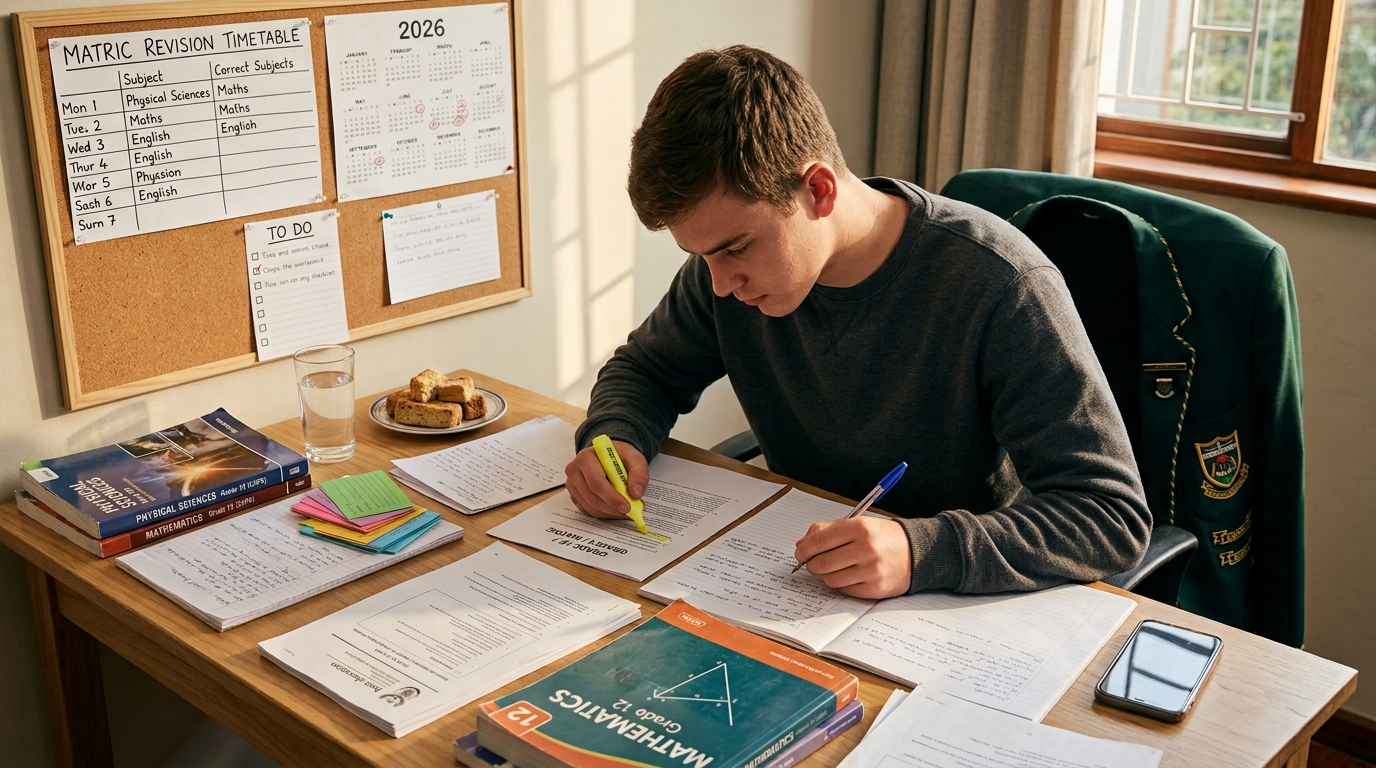
Before you touch a single textbook, fix your environment. According to Dr Nicolaas Matthee, Instructional Designer at Optimi, a dedicated study space is essential for moving information into long-term memory. Not a vague “somewhere quiet.” A specific desk, chair, and surface that your brain associates only with work.
Studying on your bed trains your brain to associate that space with rest, not retrieval. That’s a neurological mismatch you can’t out-will with caffeine and panic. Fix the space, and the studying gets easier almost immediately.
Why Your Bed Is Sabotaging Your Memory
Your bed is wired for sleep. The moment you lie down with your Accounting notes, your body starts shutting down focus systems designed for rest, not recall. This is why an hour “studying” in bed often produces less retention than 20 focused minutes at a desk.
Cognitive Load: The Science Behind a Clutter-Free Desk
Cognitive load is the mental strain your brain carries while trying to process information. A cluttered desk, a phone buzzing nearby, or background noise from the TV all add to that load, according to Optimi’s research on exam success. Clear the desk. Silence the phone. Close the door. Every object you remove is one less thing competing for the same limited working memory you need for Physical Sciences equations or Accounting ratios.
Think of it like an engine bay. A mechanic doesn’t work faster with tools scattered everywhere; they work faster with a clean, organised bay where every tool has a place. Your desk needs the same discipline.
Tell Your Family: Stop the Interruptions Before They Start
Communication prevents conflict. Paste your study timetable on your bedroom door or share it in the family WhatsApp group so nobody walks in mid-session to ask what’s for dinner. This single step removes dozens of micro-interruptions that quietly destroy focus over a study week.
Build a Study Timetable You’ll Actually Follow
A timetable isn’t a suggestion. It’s a contract you make with your future exam mark. Without one, you default to studying whatever feels comfortable, which is rarely what earns the most marks. For more tips, consider exploring the top 10 study tips from an expert.
- List every subject and the topics still outstanding
- Estimate realistic hours needed per topic, not per subject
- Map these into daily slots, protecting your sharpest hours for your weakest subjects
- Build in breaks, meals, and at least one social or exercise block per day
This is the foundation of matric study triage: deciding, with cold logic, what gets attention first based on marks-per-hour-invested, not emotional comfort.
Break Every Subject Into Manageable Chunks
Don’t write “Mathematics” on your timetable. Write “Trigonometry graphs” or “Financial maths.” Vague blocks produce vague studying. Specific blocks produce specific progress you can actually measure at the end of each session.
Match Your Hardest Subjects to Your Peak Energy Hours
Figure out whether you think clearer in the morning or afternoon, then slot your toughest work — Physical Sciences calculations, essay planning, whatever drains you most — into that window. Save lighter revision, like flashcards or re-reading notes, for your low-energy slots.
The 45-Minute Rule: Study, Stretch, Repeat
Forty-five minutes is the optimal study session length before your brain needs a reset, according to education experts at Optimi. After each block, stand up, stretch, and breathe deeply for a few minutes before returning. This isn’t laziness. It’s how memory consolidation actually works.
Trying to push through three straight hours without a break doesn’t show dedication — it shows a misunderstanding of how the brain absorbs information. Short, intense, well-spaced sessions consistently beat long, exhausted marathons.
Schedule Rest, Friends, and Fun Into Your Timetable
A timetable that only contains study blocks is a timetable you’ll abandon by Thursday. Schedule time to exercise, chat to friends, and watch something entertaining to get the balance right and stay productns. This isn’t indulgence — it’s maintenance for the machine doing all the thinking.
Figure out which slots give you the best return on energy spent. For some learners, a 20-minute power nap after lunch resets focus better than another coffee ever could. For others, a quick jog around the block clears the mental fog that builds up after three hours of Accounting ledgers.
Use Past Papers to Predict What’s Coming
If you only have time for one quick matric study tip this week, make it this one: past papers are the closest thing you have to a leaked exam. They reveal question patterns, mark allocations, and the specific phrasing examiners favour year after year.
Past papers give you a glimpse into the types of questions you can expect and the way those questions get asked. That said, don’t mistake pattern-spotting for a shortcut around the full syllabus — you still need to study all your work, not just what’s appeared in a past paper. Past papers sharpen your aim; they don’t replace the ammunition.
Where to Find Over 700 Free Past Papers
Optimi Classroom hosts over 700 past papers across every NSC subject, making it one of the most practical free resources available for a last-minute NSC exam crash course. Download the ones for your specific subjects and work backward from this year’s exam date, prioritising the most recent three years first since curriculum emphasis shifts over time.
Tackle One Topic at a Time for Faster Progress
Working through one topic at a time is more effective than jumping randomly between sections of a past paper. Finish all the algebra questions across three papers before moving to trigonometry. This builds pattern recognition faster than scattering your attention across the whole paper at once.
Try Every Question Yourself Before Checking the Memo
Attempt every problem yourself first, no matter how inadequate your first attempt feels, before consulting the memo. The struggle itself is where the learning happens. Checking the memo too early turns practice into a reading exercise, and reading exercises don’t build exam-day problem-solving muscle. For additional study tips from education experts, explore more strategies to enhance your preparation.
The real value comes after you get something wrong. The best way to learn is from your own mistakes — pinpoint exactly where the logic broke down, then rework the same question type until it clicks. This is matric study triage in its purest form: spend your limited hours on your actual weak points, not on topics you’ve already mastered.
Study With Others to Stay Sharp
Studying alone works until motivation dips, and with exams this close, motivation dips constantly. Collaborative study helps you feel positive about your progress and keeps you accountable in a way solo sessions rarely manage.
The Ideal Group Size: Why 2 to 5 People Works Best
The ideal group size is no larger than five people, though a two-person group can work exceptionally well too. Larger groups tend to fragment into side conversations; smaller groups stay focused and cover more ground per hour.
Having someone else studying next to you stops you from getting up to watch a movie or scroll social media — simple peer pressure, used productively.
How Discussion Locks Information Into Long-Term Memory
Professor Rita Niemann’s research points to group discussion as a powerful tool for shifting information into long-term memory. Explaining a Life Sciences process to a classmate forces you to organise the information logically, which is exactly the kind of mental work that builds lasting recall.
Train Your Brain With Active Recall
Passive reading feels productive. It isn’t. Active recall — forcing your brain to retrieve information without looking at the source — is consistently more effective for exam preparation than re-reading notes.
Write Down Everything You Remember After Reading
Study a section, close the book, and write down everything you remember. Knowing in advance that you’ll need to recall the material makes you study in a more alert, logical way from the start, and it leaves you with a short, honest list of exactly what you still need to learn.
Quiz Yourself on Old Work for a Reality Check
Test yourself on material you studied several days ago. This breaks the dangerous assumption that you “know this already” and delivers an honest reality check before the exam does it for you. If you can’t recall it under no pressure now, you won’t recall it under exam pressure later.
Think About How You Think: Metacognition Made Simple
Metacognition simply means thinking about your own thinking. It’s noticing the patterns in how you study — do you re-read instead of testing yourself? Do you avoid your weakest subject because it feels uncomfortable? Spotting these patterns is the first step to changing them.
Predict Your Exam Mark and Work Backward
For each subject, write down a realistic predicted mark and your honest reason for that number. This simple exercise is a mini version of a 4-Point Academic Diagnostic: it forces you to confront the gap between where you are and where you need to be, and exactly how much effort that gap requires.
Find the Study Method That Fits You
There’s no universal formula here. Routine matters, but a one-size-fits-all approach ignores how differently brains recharge. Some learners need silence; others study better with low background music. Test what works for you this week rather than copying a friend’s method blindly.
Pick Your Energy Boost: Snacks, Exercise, or Power Naps
Identify your personal energy reset — a healthy snack, a short jog, or a 20-minute nap — and build it into your schedule deliberately rather than waiting until you’re already running on empty.
7 Smart Moves for Exam Day Success
Exam day isn’t the time to improvise. This is where the Pit Crew Mindset applies: fast, precise, no wasted motion, everything checked before you move.
- Pack everything the night before — stationery, ID, calculator, water — so morning stress stays at zero.
- Arrive on time, not early — arriving too early exposes you to panicking classmates whose anxiety is contagious.
- Plan your time inside the exam room — allocate minutes per mark and leave time to check at the end.
- Skip hard questions and return later — don’t let one stubborn question eat time meant for easier marks elsewhere.
- Keep pushing until the final minute — if the paper feels tough, continue giving your absolute best right to the end.
- Use the Instant Calm Protocol™ — if panic rises mid-exam, pause, take three slow breaths, and re-read the question before reacting.
- Trust your preparation — the work is already done; exam day is simply execution.
Get Your Mindset Right Before the Exams Begin
None of these techniques matter without the decision to start today. Whether you’re in grade 11 preparing ahead or deep in grade 12 last minute revision, the clock doesn’t negotiate.
Start Today: Why Waiting Costs You Marks
Every day you delay the timetable is a day of lost structured study. Don’t dwell on what wasn’t done last month — put it behind you and start building momentum from this exact moment.
Stay Positive From Day One to the Last Exam
Staying positive until the exams are fully done matters more than most learners realise. Your exam result will reflect the hard work you’ve genuinely put in, not the anxiety you carried while doing it.
FAQ’s About Last-Minute SA Matric Study Techniques
These are the questions South African matric learners and parents ask most often when the exam countdown gets tight.
How many hours should Matric students study per day during exams?
Most learners manage four to six focused hours daily when sessions are structured into 45-minute blocks with proper breaks between them. Quality consistently outperforms raw hours, since an exhausted six-hour session produces far less retention than a sharp three-hour one. Build your daily target around energy levels and subject difficulty rather than a fixed number copied from someone else’s routine.
- Peak energy hours go to your hardest subjects
- Low energy slots suit lighter revision like flashcards
- Breaks every 45 minutes protect focus across the full day
Adjust this daily based on how each subject’s exam date approaches on the calendar.
What is the best way to study for Matric in one week?
With only a week remaining, matric study triage becomes essential. Focus almost entirely on high yield matric topics identified through past papers, since these carry the heaviest mark allocations year after year.
| Day | Focus Area |
|---|---|
| Day 1–2 | Weakest subject, highest-mark topics only |
| Day 3–4 | Second weakest subject, past paper practice |
| Day 5–6 | Active recall across all subjects, timed practice |
| Day 7 | Light review, rest, and exam-day prep |
This isn’t about covering everything. It’s about covering what pays off the most in the time available.
How do I stay motivated when studying for Matric finals?
Study with a partner or small group to create natural accountability and reduce the isolation that often kills motivation during long study stretches. Predicting your exam mark for each subject, and being honest about why, also clarifies exactly why the current effort matters right now. Motivation tends to follow action rather than arrive before it, so starting the session is often more effective than waiting to “feel ready.”
Should I study alone or in a group before Matric exams?
Both approaches have a clear place in a well-built timetable. Use solo time for active recall, practice papers, and quizzing yourself on older work, and reserve group time for discussion-heavy subjects like Life Sciences or History where explaining concepts aloud deepens understanding. Keeping any group to between two and five people maintains focus and avoids the drift into unrelated conversation that larger groups often fall into.
What should I do if I panic during a Matric exam?
Pause immediately rather than pushing forward in a panicked state, since rushed answers under stress rarely reflect true ability. Use a short breathing reset of a few slow breaths before re-reading the question calmly from the start. If a specific question triggered the panic, skip it temporarily, continue with questions you’re confident about, and return once composure has returned.
This simple pause-and-reset habit, practiced even once during a mock exam, becomes far easier to execute automatically on the real exam day.